
AI-ready logistics operations for Indian courier & 3PL networks

Run bookings, hubs & last-mile delivery with AI-assisted operations clarity

Doorear helps teams book and track shipments, coordinate network execution, and read MIS the way dispatchers actually work—then layers assistive AI to surface risk, prioritize exceptions, and speed up decisions across branches, roles, and GST-ready company profiles.

AI exception copilotSLA risk signalsStage-aware audit trail
Command view (animated)
AI signals

Delivery SLA

98.2%

At-risk lanes

3 lanes

SLA risk digest

BOM hub inward lag impacting DEL→BOM lane

Suggested: prioritize inward scans, then re-plan delivery run.

Exception copilot

Shipment AWB‑DOO‑12872

Owner: BOM hub supervisor · Next: scan inward + attach manifest note

Explainable recommendation

Built for Indian courier & 3PL operators

CEP momentum
Scale lanes and SLAs as e‑commerce and B2B freight digitize—branch-aware software, not ad hoc trackers.
PIN discipline
Validate serviceable locations before you commit capacity—fewer rescans and margin leaks on bad routes.
Tenant-safe
Isolation and roles tuned for who books vs who sees billing—built for mixed hub teams.
Usage clarity
Shipment allowances and seat limits with top-ups—see Pricing for numbers from the product.
Multi-branch native
Branches, coverage, and profiles stay in sync—less reconciliation across locations.
GST-aware
Company and billing contexts aligned to compliance workflows your finance team expects.

Trusted by operator teams

Built for the people who keep shipments moving—across booking desks, hubs, last-mile runs, and finance.

Designed for Indian courier & 3PL workflows
Courier Ops3PL NetworkDispatch DeskHub SupervisorBranch AdminFinance ControllerCustomer ServiceLinehaul TeamDelivery RunsMIS & AnalyticsCourier Ops3PL NetworkDispatch DeskHub SupervisorBranch AdminFinance ControllerCustomer ServiceLinehaul TeamDelivery RunsMIS & Analytics

India logistics context

Built for branch-heavy courier & 3PL realities

India's courier, express and parcel segment is expanding as e‑commerce and B2B freight digitize. Networks compete on lane coverage, SLA adherence, and cost per shipment—yet many mid-market operators still juggle AWBs in spreadsheets, disconnected WhatsApp threads, and legacy billing tools. Doorear aligns bookings, hub execution, MIS, and finance artifacts so leadership sees one operational truth.

GST registration, PIN-level serviceability, and multi-city hubs are not edge cases—they are the default. Doorear reflects branch hierarchy, validates coverage before you book, and keeps subscription usage (shipments, seats, top-ups) transparent inside the product.

See who we serve

Growth & pressure on SLAs

Volumes and customer expectations push networks to instrument first-mile → last-mile handoffs—not just track a single AWB in isolation.

Coverage as a moat

PIN masters and route discipline protect margin; booking validation reduces rescans and emergency linehaul spend.

Finance wants alignment

Controllers need invoices and vouchers tied to operational activity—not monthly reconciliation fire drills.

Visibility beats heroics

Dashboards for OFD, delays, and branch throughput beat status meetings that start with “let me check the sheet.”

AI-first operations foundation

AI that respects how courier ops actually run

“AI in logistics” only works when your data model matches reality. Doorear brings bookings, hub execution, and MIS into one disciplined workspace—then layers assistive intelligence on top.

Exception copilot for ops teams

Triage “why is this stuck?” faster with an AI-ready workspace: structured shipment stages, hub handoffs, and role-scoped visibility—so exceptions have context, not guesswork.

  • Stage-aware context for every shipment
  • Fast owner handoffs across branches
  • Cleaner audit trail for root-cause review

SLA risk signals (built on your MIS)

Surface what matters in standups: lane delays, OFD drift, and branch throughput patterns—so supervisors act on risk signals before they become escalations.

  • Focus on top blockers, not full exports
  • Same metrics across ops & leadership
  • Operational rhythm without spreadsheet churn

AI-ready data foundation

Doorear keeps bookings, manifests, inward legs, and delivery runs in a consistent system of record. That structure is what makes AI outputs dependable in operations.

  • Structured bookings + coverage validation
  • Consistent network execution artifacts
  • Permissioned access for mixed teams

Smarter decisions, not noisy automation

We focus on assistive intelligence—suggestions and prioritization—so operators stay in control while the system reduces manual scanning for answers.

  • Human-in-the-loop by design
  • Clear “why” for recommended actions
  • Designed for real courier workflows

AI-ready by designNo black-box claims: the “AI layer” is only as good as the data model underneath. Doorear starts with operator-grade structure.

AI in 30 seconds

What “AI-assisted operations” looks like in practice

No hype—just a workflow that helps supervisors and dispatchers prioritize the right actions faster.

Live-style preview

stage-aware

AI risk signals

Assistive intelligence, grounded in shipment stages and MIS.

signal
Lane
DEL → BOM
Risk
High (OFD drift)
Likely cause
Hub inward lag at BOM
Suggested action
Prioritize inward + replan delivery run
Recommended actions stay explainableHuman-in-the-loop by design

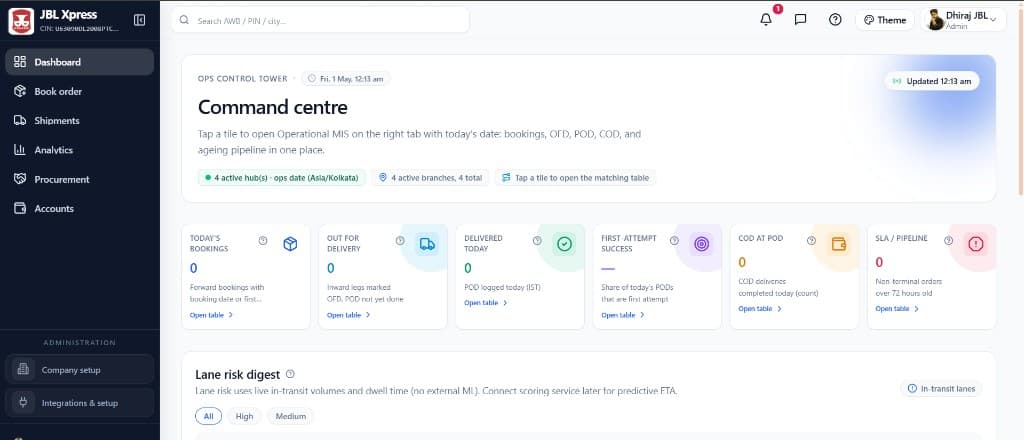
Product UI on the site

We surface real in-app screenshots across the site—MIS and access on Features, hub execution on Solutions, and commercial analytics next to plans on Pricing—so each page earns its visual instead of stacking everything on the homepage.

Platform depth

Courier management software that maps to your operating model

Doorear connects booking, network execution, analytics, procurement (when enabled), and GST-oriented account artifacts—so Indian courier and 3PL operators replace stitched spreadsheets with a disciplined operator workspace.

Forward booking & AWB-style orders

Capture consignments with structured booking screens instead of scattered forms. Every revision stays in one shipment booking software system of record so customer service, hubs, and finance reference the same AWB story.

  • Fewer duplicate or conflicting entries across branches
  • Cleaner handoff to billing and customer communication
  • Operational audit trail as bookings evolve

Bags, manifests, inward legs, delivery runs

Model how freight actually moves: group consignments into bags, attach manifests, run inward legs into hubs, and schedule delivery runs to POD. Supervisors see stage-level status—not only “in transit.”

  • Clear accountability between first mile, hub sort, and last mile
  • Easier root-cause review when a lane slips
  • Better alignment with last mile delivery operations software expectations

Branch hierarchy & branch-scoped users

Configure parent branches, child sites, and user access that mirrors your org chart. Each team works inside multi branch courier software boundaries that match operational responsibility—not a single flat tenant.

  • Right data visibility for hub managers vs central ops
  • Safer rollouts when you onboard new cities
  • Cleaner delegation as you franchise or partner last-mile

Serviceable PIN / location master

Validate whether a lane is truly serviceable before you burn capacity. Coupled with disciplined booking, you reduce emergency linehaul, return-to-origin noise, and margin leakage on “we thought we could deliver there” scenarios.

  • Pre-booking validation against your coverage model
  • Fewer invalid routes entered by frontline teams
  • Better network planning conversations with commercial

Operational dashboard & MIS

Give leadership and hub heads in-product MIS views tuned for daily operations: pipeline volume, delays, OFD progress, and branch throughput—so standups start from the same screens finance exports, not anecdotes.

  • Faster reaction to recurring choke points
  • Shared metrics across ops and branch managers
  • Foundation for continuous improvement programs

Sales & purchase analytics (where enabled)

When your tenant enables commercial modules, procurement and revenue-side charts sit next to operations—founders and finance controllers see margin and vendor performance in the same workspace as shipment activity, grounded in live data instead of parallel spreadsheets.

  • Tighter alignment between ops reality and commercial decisions
  • Less spreadsheet reconciliation for procurement RFQ logistics software flows

Roles, invites & secure access

Granular permissions separate who creates bookings, who edits company setup, who exports financials, and who administers users. Optional modern sign-in options support enterprise expectations without slowing branch onboarding.

  • Least-privilege access for mixed hub teams
  • Audit-friendly change patterns for regulated customers

Multi-tenant isolation & subscriptions

Each company operates in isolated tenancy with subscription plans that surface trials, usage, shipment allowances, seat limits, and top-ups—so finance and operations share the same transparent story.

  • Clear expectations on capacity vs purchased add-ons
  • Honest enterprise buying: coordinate offline payments when checkout is not in-product

End-to-end flow

From booking intent to proof of delivery

Doorear connects operational steps your teams already perform—now with a single audit trail, fewer manual exports, and permissions that match responsibility.

01

Book & validate

Create forward bookings and AWB-style orders against your serviceable PIN / location master—stop bad routes before they consume capacity.

02

Execute network handoffs

Run bags, manifests, inward legs, and delivery runs so supervisors see where consignments sit from first mile to POD.

03

Measure & improve

Use operational MIS for pipeline health and delays; add sales & purchase analytics when your org enables those modules.

04

Govern access & billing

Branch-scoped users, granular roles, subscription allowances, and optional offline finance coordination—aligned to how Indian enterprises buy.

See Doorear on your data model

Book a live walkthrough to map branches, permissions, MIS, and subscription allowances to your network. Use Get Started when you are ready to pilot with a defined hub set and success criteria.

Frequently asked questions

What is Doorear used for?
Doorear is a cloud logistics operations platform for courier and logistics companies: book and track shipments, coordinate hubs and last-mile delivery, run operational and commercial analytics, and manage branches, coverage, fleet, partners, users, and roles in one workspace.
Does Doorear support multiple branches?
Yes. Branch hierarchy and branch-scoped users mirror real networks so each site sees the right bookings, manifests, and delivery runs—core to multi branch courier software.
Can we control who books shipments vs. who sees analytics?
Yes. Roles and granular permissions let you separate operational actions from sensitive analytics and company setup—reducing risk across teams.
How does billing work for the subscription?
Plans include trials, usage reminders, and renewal transparency. Where in-product payment checkout is not the default, teams coordinate offline with finance—see Pricing for details.